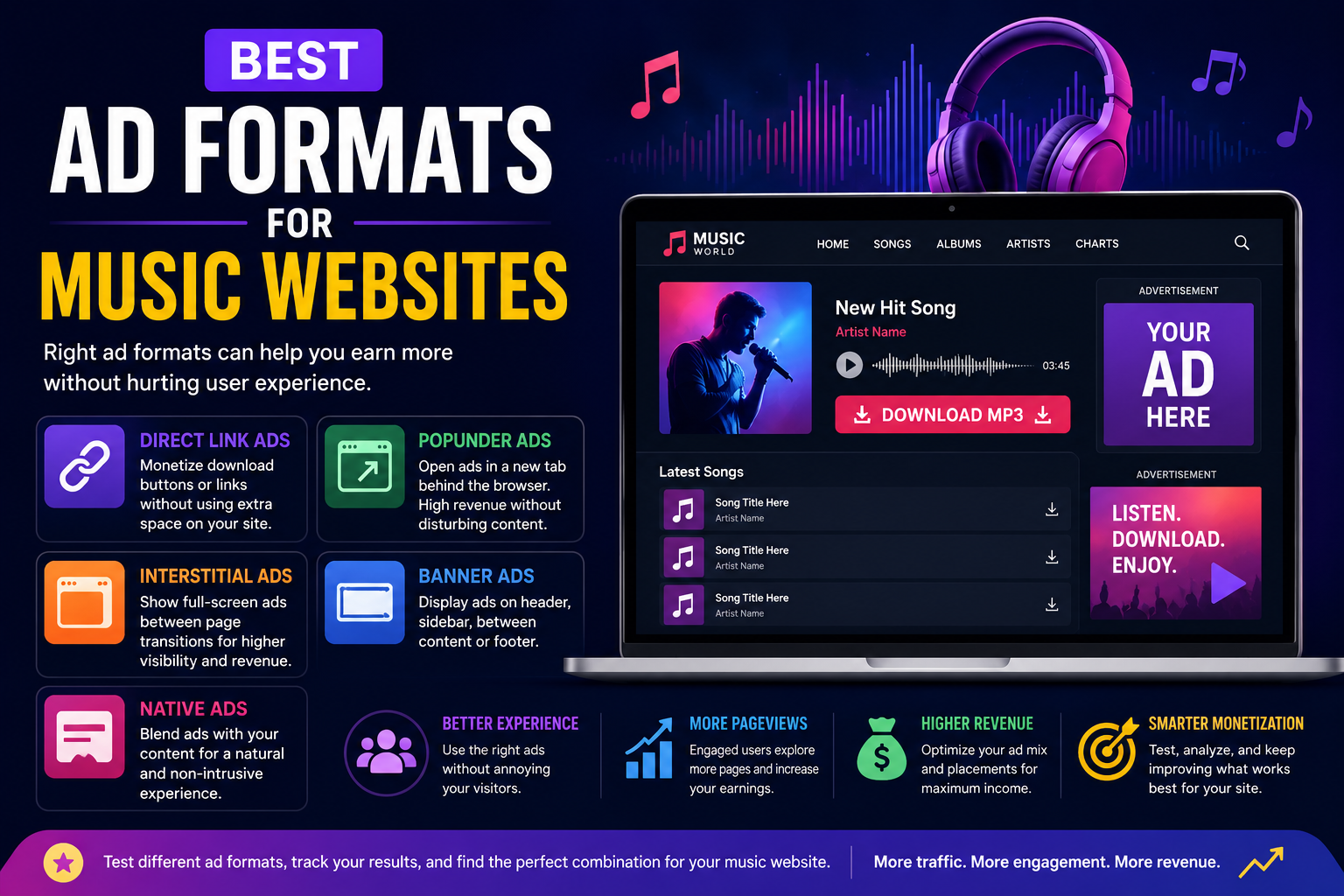
Learn which ad formats work best for music and MP3 websites, including Direct Link, Popunder, Interstitial, banner and native advertising.
Running a music website is one thing. Monetizing it properly is another.
Music and MP3 websites can receive a lot of visitors, but the way those visitors use the site is different from a typical blog. Someone may visit just to download one song and leave, while another visitor may browse several artists, albums and new releases.
Because of this, choosing the right ad format can make a big difference to your earnings.
There isn't one ad format that is perfect for every music website. The best approach is usually to test a few formats, watch your numbers and find what works best for your audience.
Here are some of the ad formats worth considering.
1. Direct Link Ads
Direct Link is one of the formats I would consider for a music or download website.
Instead of placing a traditional banner on the page, you can monetize a link or clickable element on your website.
For example, a download section might have:
Download MP3
The link can be monetized through an advertising network.
One advantage of this format is that it doesn't require a large advertising space on the page. This can be useful for mobile-first music websites where screen space is already limited.
However, the placement matters.
You want the visitor to understand what they are clicking. Avoid making the page confusing by disguising advertisements as the actual download.
2. Popunder Ads
Popunder ads are also commonly used on music, entertainment and download websites.
The basic idea is simple. A visitor interacts with the website and an advertising page can open in a separate tab or window, depending on the browser and ad network.
The main attraction for publishers is that popunders don't take up space inside the actual content.
This makes them particularly useful when you want to monetize a website without covering the music information or download section with banners.
But there is a catch.
Don't overdo it.
Showing too many popunders to the same visitor can make the website frustrating to use. It can also encourage visitors to leave instead of browsing more pages.
A sensible frequency limit is usually better than trying to show an ad on every interaction.
3. Interstitial Ads
Interstitial ads are full-screen advertisements that appear between parts of the user's browsing experience.
They are highly visible, which is why they can generate good revenue when used correctly.
For a music website, an interstitial might be shown during a natural transition between pages or actions.
For example:
Song page → user continues browsing → interstitial → next page
The important thing is to make sure the advertisement doesn't interfere with the visitor's ability to use the website.
If visitors constantly encounter full-screen advertisements before they can do anything, the extra revenue may not be worth the drop in user experience.
4. Banner Ads
Banner advertising is probably the format most website owners are familiar with.
You can place banners around areas such as:
- Header
- Sidebar
- Between content
- Below song information
- Footer
Banners are easy to understand and can work well when you have strong advertiser demand.
The problem is that visitors can become accustomed to seeing them.
This is sometimes referred to as banner blindness. People may simply ignore standard banner positions because they're used to seeing advertisements there.
For that reason, I wouldn't fill every available space with banners.
A clean website with strategically placed advertising can often be better than a page covered in ads.
5. Native Advertising
Native ads are designed to look more like the surrounding content.
On a music website, they could appear as recommended content or sponsored recommendations between regular posts.
For example:
You may also like
New Afrobeats Releases This Week
Top Songs Trending This Month
Sponsored recommendation
The advantage is that native advertising can fit naturally into a content-heavy website.
However, sponsored content should still be clearly distinguishable from editorial content. Your visitors should know when something is an advertisement.
So which ad format is best for a music website?
There isn't a universal answer.
It depends on your:
- Traffic volume
- Traffic GEO
- Website design
- Audience
- Mobile/desktop ratio
- Number of pageviews per visitor
- Type of music content
- Advertiser demand
For a download-focused website, I would personally start by testing Direct Link + Popunder + Interstitial rather than immediately filling the site with banners.
For a music blog with longer articles, native ads and banners can also make more sense.
Don't judge an ad format by CPM alone
This is important.
A network might advertise a $5 CPM, but that doesn't necessarily mean you'll make $5 for every 1,000 visitors.
Your actual earnings depend on things such as fill rate, impressions, GEO, engagement and the amount of traffic that can actually be monetized.
Instead of asking only:
"What CPM do you pay?"
look at:
"How much revenue does my website actually generate?"
For example, compare your RPM, total daily revenue and overall visitor behaviour after testing an ad format.
That's a much better way to decide what works.
Test before making a decision
If you're not sure which format to use, don't guess.
Run a simple test.
Test 1
Direct Link only.
Test 2
Direct Link + Popunder.
Test 3
Direct Link + Interstitial.
Then compare the results.
Keep an eye on:
- Revenue
- RPM
- Pageviews
- Session duration
- Returning visitors
- Bounce rate
- User complaints
After a few weeks, you'll have a much clearer picture of what works for your audience.
What about PayBela?
If you're looking for a network to test these formats, PayBela.com offers Direct Link, Popunder, and Interstitial advertising formats for publishers.
For a music website, you can test these formats individually or in different combinations and see which one gives you the best overall return.
The important thing is not simply to chase the highest CPM. Your goal should be to maximize revenue while keeping visitors comfortable enough to continue using your website.
Final thoughts
Music websites have several ways to generate advertising revenue, but more ads don't automatically mean more money.
The best setup is usually the one that fits the way your visitors use the website.
Start with a few formats, test them properly and pay attention to the actual revenue you're generating.
Find the balance between monetization and user experience.
That's what turns traffic into a sustainable website business.